ABOUT ART
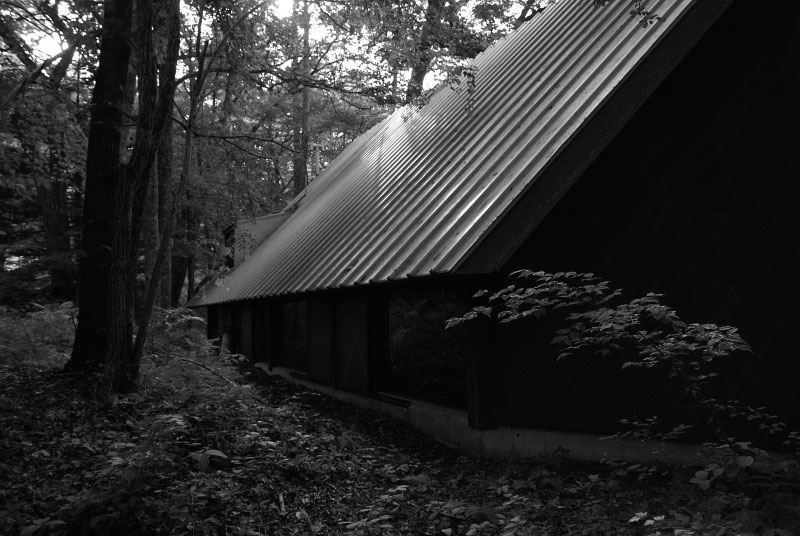
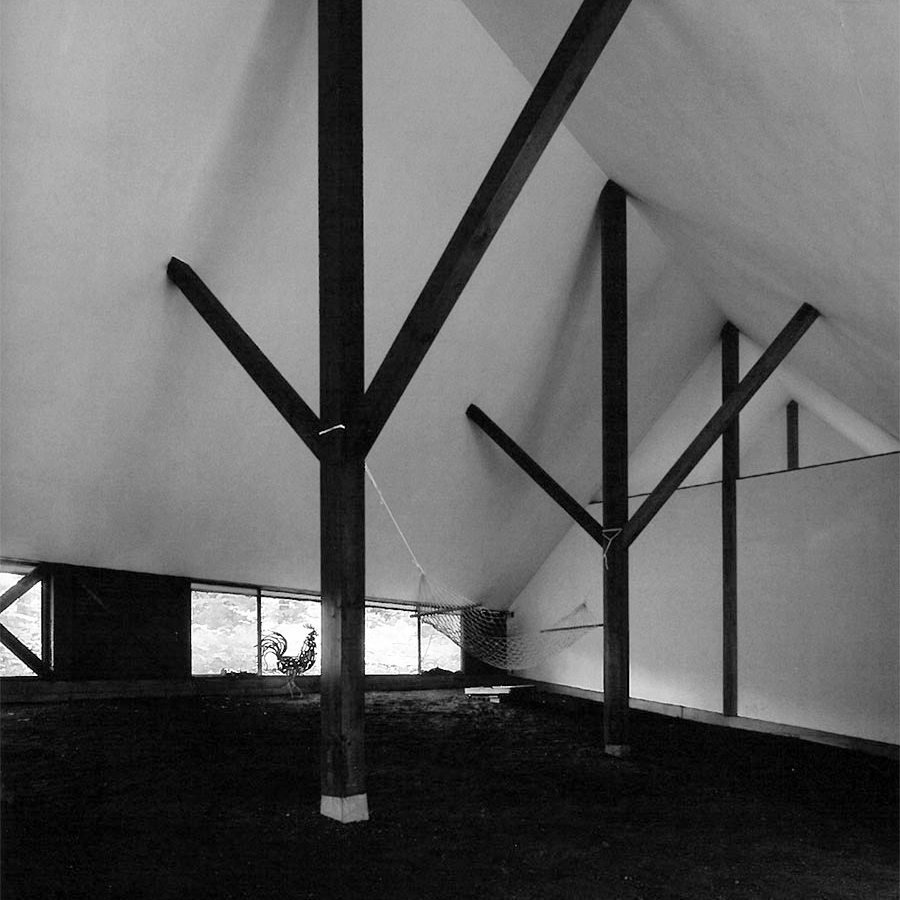
In the middle of a forest in Nagano, there's something that looks like a stable for tiny horses. Its sloped roof almost touches the ground. The soil around it is exposed, and once inside, you find the same soil. No floor, just a slope. And a timber structure that resembles two giant chicken feet supporting the roof.
The room beside it... nobody cares about that part.
This space has an "illogical function," as its architect, Kazuo Shinohara (1925-2006), calls it.
Oh, I forgot to mention something. This is a house. Well, half of a house. The other half? We don't care about that part.
What we care about is the dirt, the slope, the roof, the timber structure...
We need to make some sense of this.
Let's do a quick exercise. Let's try to name this space.
A doma?
You know, the earth-floored space found near the entrance of traditional Japanese farmhouses?
It looks like a doma because of the exposed earth, but it doesn't function like one at all.
Where's the furnace?
Maybe if I could see a shikidai leading into the raised interior, or a tetsubin hanging over a hearth nearby...
More importantly, this earth isn't even packed.
It's not that this space doesn't make sense at all. It's that it doesn't make sense inside a house.
Even less so as the largest room in it.
There's an aphorism by the architect, Kazuo Shinohara, that makes me think about this house:
"A house is a work of Art."
I'm writing Art with a capital A on purpose, because I think that, with this aphorism, Shinohara was making a statement not just about what a house should be, but about what an artist's purpose should be.
A conventional house is meant to be comfortable and predictable. Every space in it has a function and, therefore, a specific name associated with that function. The BATHroom, the LIVING room, the BEDroom... But Shinohara's philosophy goes against this: a house should also take you out of everyday domestic life, give your mind room to question it, and allow you to imagine new possibilities.
I forgot to mention that Tanikawa House was designed for the famous Japanese poet Shuntaro Tanikawa (1931–2024). So, if I had to guess, the exposed-earth space—or Summer House, as Shinohara called it—was meant to be a place for contemplation. A sort of sacred space hidden in the middle of the forest, away from noise and distractions, where you could connect with your inner self.
And why the earth floor?
To remind you that you're not just inside a house. You're inside a work of Art.
Then, this aphorism works both ways. It tries to define both the House and Art, or at least their purposes.
What should the purpose of Art be, then?
I think it should aim to produce a certain discomfort in the spectator. Not discomfort for the sake of making someone feel uncomfortable. Actually, I'm trying to distance myself as much as possible from works like The Human Centipede, which seem more interested in provoking a reaction from the audience than in having anything substantial behind them.
What I'm saying is that Art should show us something that makes us question our lives, our surroundings, society, or even reality itself. It can do this by opening up new perspectives, revealing something that was previously hidden, or reflecting something within ourselves that we'd rather not see.
Does this discomfort have to be unpleasant? I think that depends on the spectator. It could be an "ugly" work of Art or a "beautiful" one. It doesn't matter. It's up to the artist to decide on the medium, form, and aesthetics.
But I think that if artists keep this purpose in mind, it becomes easier to make decisions along the way.
But if the artist tries to control the audience's reactions, I think it will only hinder the work. It will make it less interesting. It won't generate as much discussion, and it won't challenge culture as much as it should.
Meaning should remain in the shadows. Let the critics try to figure it out.
This also means that artists should accept that some people will completely misunderstand their work. Either because they haven't put much effort into thinking about it, or because, although they might not recognize it themselves, the work threatens their lifestyle or worldview.
They might feel so uncomfortable when confronted with something they've actively tried to avoid seeing that they could even become angry at the work, and at the artist too.
In the case of Tanikawa House, we have to acknowledge the fact that it was designed for a poet, a famous one at that. But I think there must have been days when Tanikawa-san woke up and asked himself, "Why did I agree to this?"
I'm pretty sure he got plenty of inspiration from just standing or sitting on that exposed earth. But I wonder if, from time to time, it all just seemed stupid.
This is why I say it's up to the critics to sort out the meaning(s) and consequences of a work of Art. The artist needs to produce. There's no time to overthink. And thinking too much about a piece could eventually kill it.
As I said before, the artist shouldn't aspire to have everything under control.
The artist's job is to create.
Hopefully, something uncomfortable.