SOMETHING WORTH READING
I don't know whether I could write a decent book now. That is the greatest fear of all. — John Steinbeck, Working Days (1938-1941)
Be careful, writing may kill you. It was October 26, 1938, and John Steinbeck was feeling exhausted and ill. Just a couple of days earlier, his stomach had gone to pieces and he'd spent the day sleeping. For almost seven months, he'd been working on what would become his most celebrated novel, and he was determined that this would be his last day working on it. Sitting at his desk, pencil in hand, he was feeling terribly dizzy. The exhaustion was almost unbearable. I wish I were done, he thought. So he pushed through. Through the exhaustion and illness, he finished The Grapes of Wrath on October 26, 1938. Afterward, he wrote in his journal: Finished this day—and I hope to God it's good.
I don't see myself as a writer at all. Funny thing, neither did Steinbeck, although his novel tOf Mice and Men (1937) had already been a huge success on stage. And I thought I was the one suffering from impostor syndrome... But somehow, I can relate to what he felt on that October morning in 1938.
Now that I have a blog, I've started to feel this strange pressure that everything I write must be good. I draw as well, so I can't help connecting the two, particularly their aesthetic aspects. There's clearly an aesthetic dimension to writing. I constantly adjust, erase, and rewrite. I even read the sentences in my head to check how they sound. Does the sentence I just wrote look as beautiful and simple as I'd like it to? And so I find myself staring at the blinking vertical line on my screen, waiting for me to make a decision.
STYLE VS ÉCRITURE
In Writing Degree Zero (1953), Roland Barthes distinguishes between three dimensions of literary expression:
1. Language (langue): The shared linguistic system a writer inherits.
2. Style (style): The writer's individual, deeply rooted mode of expression, shaped by personal history and sensibility.
3. Writing (écriture): The historically and socially situated choice of literary form through which a writer positions their work.
Speaking of style, there's more to it than just a collection of aesthetic preferences. And just as with drawing, it doesn't emerge solely from my inner world; it also has to do with how my body works. Every word is like a stroke on the page (or screen). Every movement of my fingers, wrists, elbows, and shoulders directs my writing. I think that must be one of the reasons why many writers preferred handwriting their drafts over using typewriters.
So I have to ask myself: when I constantly adjust, erase, and rewrite, am I developing my own style, or am I trying to conform to an ideal of what good prose should look like?
I think there are two aspects to it. I must have inherited a way of writing from somewhere, but there's also a psychological issue of wanting things to be as perfect as possible.
Regarding the first one, there were three experiences at university that shaped the way I write today.
Among my Master's courses, there was one called Argumentos Proyectuales (something like Design Arguments), where we had to develop an essay based on a specific object of study. At the time, as part of my thesis research, I was beginning to analyze House & Atelier by the Japanese architecture firm Atelier Bow-Wow. More specifically, its entrance garden.
The first task was to write a description of our object of study. There was this idea of starting with something small: a detail, an anecdote, a character... something that didn't feel like the introduction to a Wikipedia article, before moving on to something bigger or more complicated. There were also some rules, like writing no more than thirty words per sentence and using no more than one complicated word in a sentence. So I started my essay by describing the entrance garden as if the reader were approaching it from the street. From there, we would move on to analyze the object of study from a particular point of view, always in a very "labyrinthine" way, closing with a paragraph that left more questions than answers.
That semester, I also participated in a short English writing seminar led by Thomas Weaver, an editor at MIT Press. He's a very good teacher and a kind person. Every week, we would gather to present and discuss a mini-essay, just one page long. I mostly remember my second one, about the act of looking at the city from above and its architectural consequences. Now, on top of what I'd learned in Argumentos Proyectuales, I was learning to get rid of certain writing clichés and bad habits.
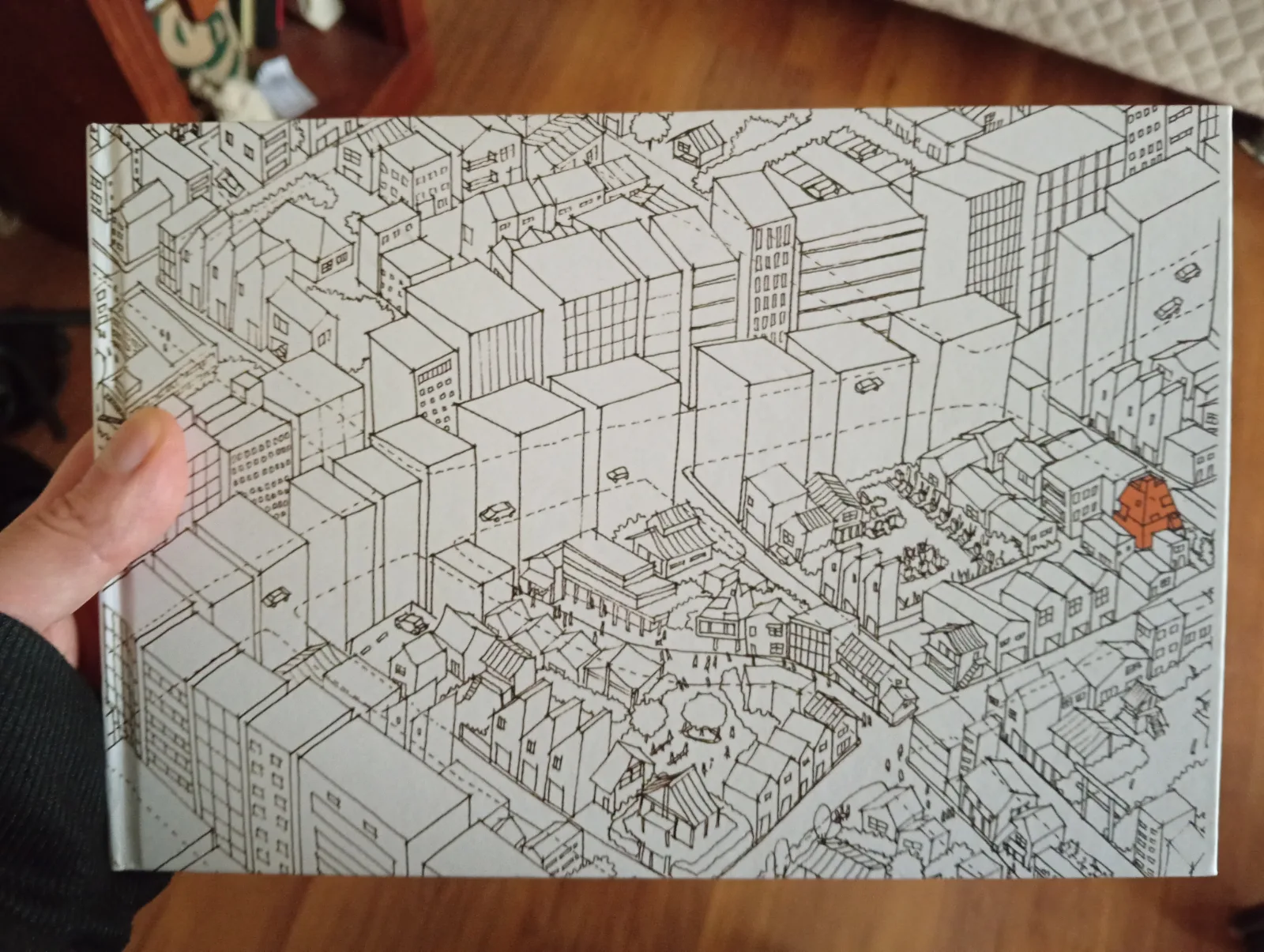
Finally, I would apply all of this in my thesis, Entre Nosotros (In-Between Us), a collection of three essays exploring translation and the contrasts between a neighborhood in Sugacho (Tokyo, Japan) and one in Matta Sur (Santiago, Chile). This was when I put into practice everything I'd learned in the previous course and seminar. I even ended up printing my thesis in royal octavo format, with a beautiful white hardcover.
I think I learned a lot during this period, but I've also recently realized that when I write, I don't have many tools beyond description and analysis. Or maybe I do, but I haven't fully developed them yet.
This summer, for example, I tried to write a book, and it turned out awful. The prose was terrible. Reading it myself, I could see that it was all description, nothing else. "Here's this character, this happened to her, then this happened, and after that, this." I couldn't even finish the first chapter. I just had a rough idea of the events in my head, but I didn't know how to expand on it. I ended up deleting the whole thing.
But that book became the seed for my comic in development, MVNDY. A lot of the ideas in MVNDY came from it. Adapted, obviously. It's like it was never meant to be a book. There was something I couldn't communicate through writing alone, or, more precisely, drawing and dialogue needed to be at the center of it.
So looking back, was it really a failure?
DESIRE TO WRITE VS WRITING
There's another book by Barthes that's very relevant to what I'm trying to elucidate here, called The Preparation of the Novel (1978–1980). Regarding my psychological issue with perfectionism, I'll allow myself to draw another parallel between Barthes and myself.
After his mother's death in October 1977, Barthes began imagining a novel called Vita Nova (New Life), partly inspired by Dante, which represented the possibility of beginning again for him. After decades of being a literary critic, Barthes now wanted to become a novelist. And he felt pressure because of his established public identity as a critic. Moving into fiction meant confronting the expectations associated with his previous work, as well as the possibility of failure. But there was also pressure coming from within. After all those years of accumulating literary knowledge, he now wanted to put it into practice and produce a literary work of his own.
What should I write about? How should I begin? What form should I use?
These were the kinds of questions Barthes had to confront.
I'm not writing a novel, but these are the same questions I ask myself every time I think about my blog. I feel the pressure to hook the reader from the start. That's why the first thing I decide on is the title. I don't write without a title. Not that it's a bad thing. That's actually something I learned from the writing course, and it makes directing the essay much easier. But I feel there's something else I'm lacking.
RAWNESS VS POLISH
Never mind the misses and the stumbles. — Virginia Woolf, A Writer's Diary (1919)
I think we are well advised to keep on nodding terms with the people we used to be. — Joan Didion, On Keeping a Notebook (1966)
I remember a time when I used to keep a diary. The last one was a handmade notebook made of textured paper. It's beautiful. In those days, I also used to read tarot for myself a lot, and I recorded those readings in a black Fabriano notebook. Every morning, I would practice Trataka (candle gazing), a kind of meditation that, from personal experience, makes my mind feel more alert. I found it especially good to do early in the morning, before the sun came up. Then I'd use colored pencils to try to portray what I saw. After that, I'd do a simple three-card reading, trying to address some concern that was bothering me. At night, I'd reflect on my day, my mental state, my relationships... everything I needed to get out of my head and examine. I'd also write down ideas the moment they came to me.
I think this is a very healthy habit, one that writers like Virginia Woolf, Joan Didion, and Barthes himself practiced in different ways. Woolf used her diary for observation, experimentation, and reflection. Didion's notebooks were closely related to memory and personal identity. Barthes's notes and fragments also served his intellectual and literary projects.
I'd say it's a cornerstone of developing a writing habit, and it helps preserve that raw, personal style that emerges when there isn't the pressure to produce something publishable.
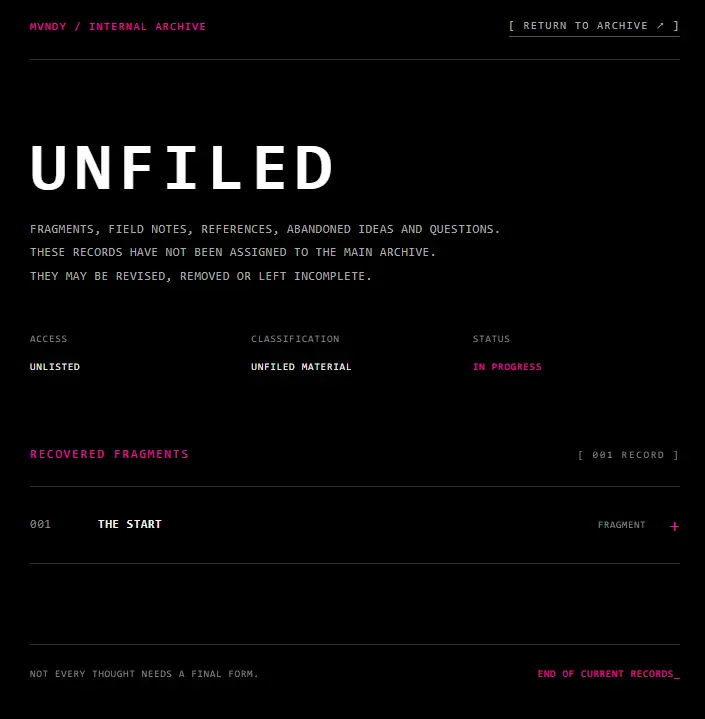
So I decided to vibe-code my own digital notes editor with its own public archive. It's called UNFILED, and it's hidden somewhere on the MVNDY website.
So now I wonder: what purpose am I going to give this digital diary/notebook? And also, why am I making it public and not private?
I mean, this is an experiment, so I hope I can answer those questions in the coming weeks.